Learning how to calculate your daily power usage off-grid is a fundamental step toward designing a reliable and efficient off-grid power system. Put simply, you need to know how much electricity you’ll gobble up each day to figure out what size solar panels, batteries, and charge controllers you’ll need. Without this crucial number, you’re essentially guessing, which can lead to an undersized system that leaves you in the dark or an oversized one that busts your budget. It’s not as daunting as it sounds, and with a bit of methodical thinking, you’ll be well on your way to energy independence.
Think of it like this: you wouldn’t embark on a long road trip without knowing how much gas your car consumes or how far you need to travel, right? The same logic applies to off-grid living. Your daily power usage, often measured in Watt-hours (Wh), is the cornerstone of your entire system design. Ignoring this step can lead to a world of frustration.
Table of Contents
Avoiding Under-Sizing Your System
An undersized system is a frequent rookie mistake. You invest in panels and batteries, excitedly hook everything up, and then find yourself running out of power halfway through the day, especially on cloudy days. This means your fridge stops working, your lights flicker, and your devices remain uncharged. It’s not just an inconvenience; it can be costly to upgrade later with additional components and labor.
Preventing Over-Sizing Your System
Conversely, oversizing your system, while ensuring you never run out of power, can be a huge waste of money. Solar panels, batteries, and charge controllers aren’t cheap. Buying more capacity than you genuinely need means you’ve tied up capital that could have been used elsewhere – perhaps for better appliances, a more comfortable living space, or even an emergency fund. Plus, oversized systems can sometimes lead to inefficiencies in battery charging, depending on the technology.
Ensuring System Longevity
When your system is properly sized, it operates within its optimal parameters. Batteries aren’t constantly being drained to critical levels, and panels aren’t being pushed beyond their design. This careful balance extends the lifespan of your expensive components, saving you money on replacements down the line and reducing your environmental footprint.
If you’re looking to understand more about managing your energy consumption while living off-grid, you might find the article on How to Size an Off-Grid Solar System particularly helpful. It delves into various methods for calculating daily power usage, offering insights that complement the information on how to calculate your daily power usage off-grid. By exploring this resource, you can gain a deeper understanding of energy efficiency and sustainable living practices that are essential for off-grid lifestyles.
Gathering Your Appliance Information
This is where the detective work begins. You need to list every electrical appliance you plan to use and gather some key information about each. Don’t forget those small, often-overlooked items!
The Appliance Inventory
Grab a notebook or open a spreadsheet. Go through your home, cabin, or RV room by room and make a comprehensive list. Think about:
- Kitchen: Refrigerator, freezer, microwave, toaster, coffee maker, electric kettle, blender, food processor, electric stove/oven (if applicable).
- Living Area: TV, streaming device, stereo, lamps, fan, laptop charger, phone charger.
- Bedroom: Lamps, alarm clock, heating pad, electric blankets (if planned).
- Bathroom: Hair dryer, electric toothbrush, electric shaver.
- Utility/Outdoor: Water pump, well pump, washing machine, dryer (if electric), power tools, outdoor lights, security cameras, Wi-Fi router, modem.
Be thorough. Even small items add up over time.
Finding Wattage (or Amperage and Voltage)
Once your list is complete, you need to find the power consumption of each item. This is usually listed in Watts (W) on a label, sticker, or in the appliance’s manual. It’s often found on the back or bottom of the device.
- Look for a label: Most appliances have a data plate or sticker that specifies voltage (V), amperage (A), and/or wattage (W).
- Manuals: If you can’t find a label, check the user manual or product specification sheet online.
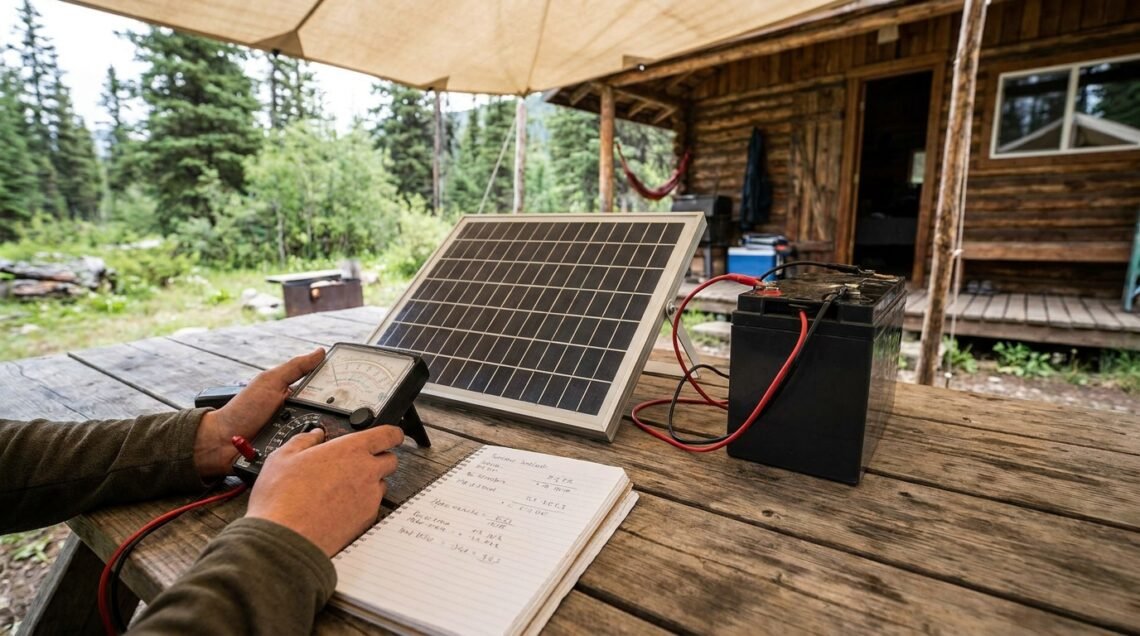
- Energy Meters: For more accurate readings, consider purchasing a simple “Kill-a-Watt” style energy meter. You plug the appliance into it, and it tells you the current power draw. This is especially useful for items like refrigerators, which cycle on and off.
- Estimates: If all else fails, you can find average wattage estimates online for common appliances, but this should be a last resort, as actual consumption can vary.
If you only find Amperage (A) and Voltage (V), you can calculate the wattage using the formula: Watts (W) = Amps (A) x Volts (V). For example, an appliance drawing 2 amps at 120 volts consumes 240 watts. Most off-grid systems use AC power (like grid power) for larger appliances, so 120V is a common starting point for that calculation. Small DC appliances (like some RV lights) will often reference 12V or 24V.
Calculating Daily Watt-Hours (Wh)
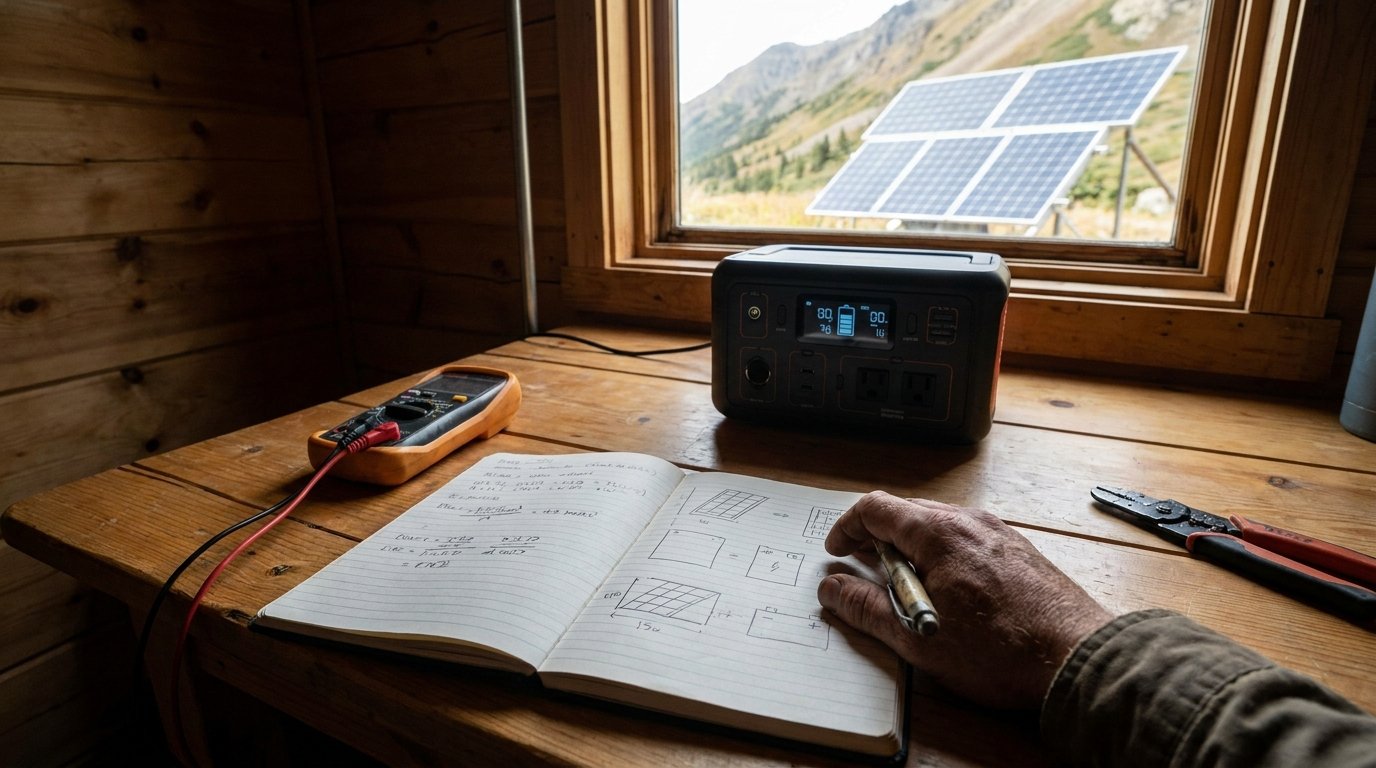
Now that you have your list of appliances and their wattages, it’s time to figure out how much energy each uses over a typical 24-hour period. This is where “Watt-hours” come in.
Estimating Daily Usage Time
This is a critical step and requires honest assessment. For each appliance, estimate how many hours per day it will actively be running.
- Continuous Use: For things like a refrigerator, even though it cycles, you account for it being “on” 24 hours a day, but with its duty cycle in mind (more on that in a moment). Other items like a Wi-Fi router might truly be on 24/7.
- Intermittent Use: For items like a microwave, you might use it for 5 minutes total each day. A laptop charger might be plugged in for 3 hours. A light bulb might be on for 4 hours in the evening.
- Peak Use: Consider seasonal variations. Will you use a fan more in the summer? A heavier heating load in winter? If you’re designing for year-round off-grid living, you’ll want to calculate your highest expected daily usage.
Be realistic. It’s better to slightly overestimate than underestimate, especially when starting out.
Dealing with Cycling Appliances (e.g., Refrigerator)
Appliances like refrigerators and freezers don’t draw their full wattage continuously. They cycle on and off to maintain temperature. This “duty cycle” is typically between 30% and 50% for modern, efficient units, but can be higher for older or less efficient models.
To calculate for a refrigerator:
- Find its running wattage: (e.g., 150 Watts)
- Multiply by 24 hours: 150 W * 24 h = 3600 Wh (This is if it ran constantly, which it doesn’t).
- Apply the duty cycle: Multiply the continuous Wh by the estimated duty cycle. If you assume a 40% duty cycle: 3600 Wh * 0.40 = 1440 Wh/day.
If you’re unsure of the duty cycle, a Kill-a-Watt meter can provide a very accurate daily Wh reading by monitoring the fridge for 24 hours.
The Watt-Hour Calculation Formula
For each appliance, apply this formula:
Daily Watt-hours (Wh) = Appliance Wattage (W) x Hours Used Per Day (h)
Let’s do an example for a few common items:
- LED Light Bulb: 10 W * 4 hours/day = 40 Wh/day
- Laptop Charger: 60 W * 3 hours/day = 180 Wh/day
- TV: 80 W * 2 hours/day = 160 Wh/day
- Water Pump (1/2 HP): A 1/2 HP pump might draw around 750 Watts. If it runs for 30 minutes (0.5 hours) total per day: 750 W * 0.5 h = 375 Wh/day
- Phone Charger: 10 W * 2 hours/day = 20 Wh/day
- Refrigerator (as calculated above): 1440 Wh/day
Once you’ve done this for every item on your list, add up all the individual daily Watt-hours.
Total Daily Watt-hours (Wh) = Sum of all individual appliance Daily Wh
This total is your average daily energy consumption.
Accounting for System Inefficiencies and DC vs. AC Loads
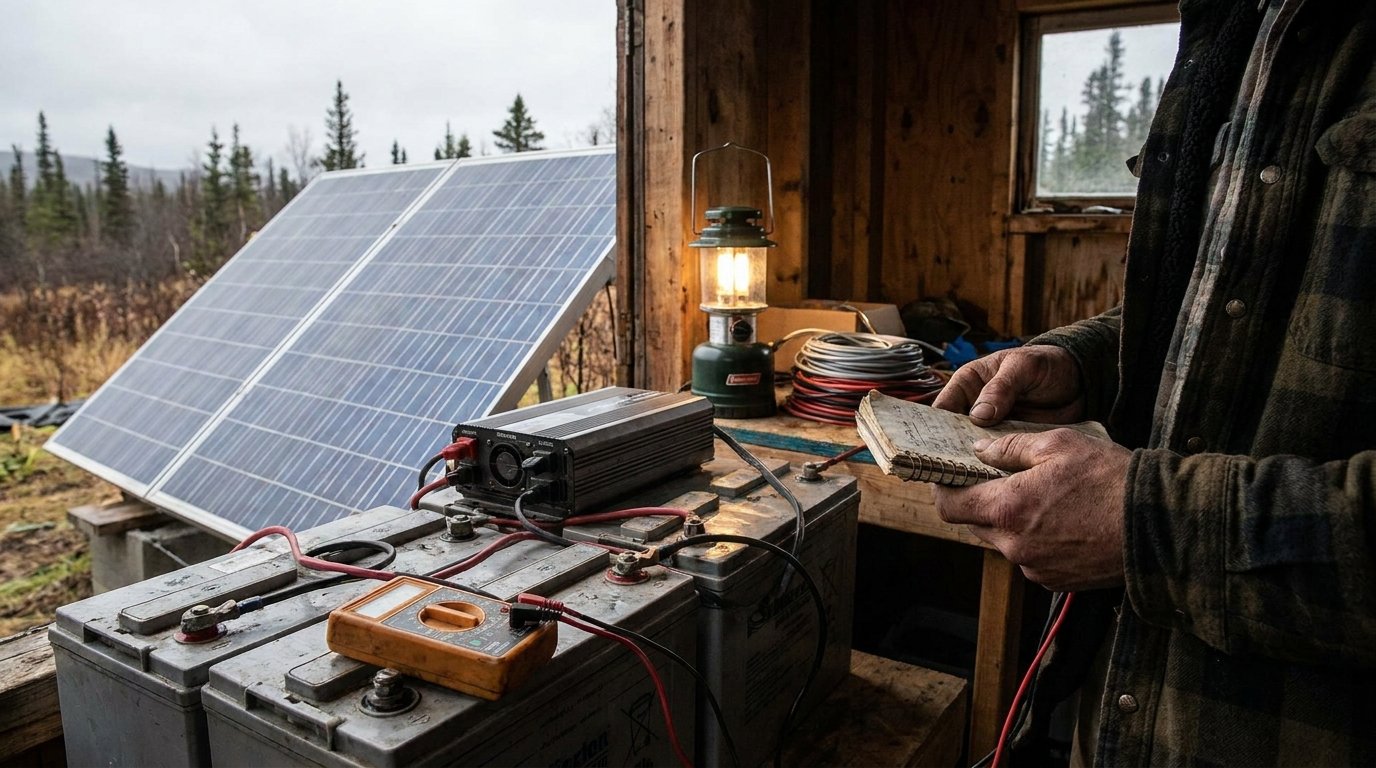
Your calculated Watt-hours are a great starting point, but an off-grid system isn’t 100% efficient. Energy is lost at various stages.
Inverter Efficiency
Most standard off-grid systems use an inverter to convert the DC (Direct Current) power from your batteries to AC (Alternating Current) power needed by most household appliances. Inverters aren’t perfectly efficient; some energy is lost as heat during this conversion.
- Typical Inverter Efficiency: Good quality inverters are usually 85-95% efficient. Let’s use a conservative 90% for our calculations.
- Adjusting for Inverter Loss: If your total daily usage is 3000 Wh, and your inverter is 90% efficient, you actually need to draw more than 3000 Wh from your batteries.
- Battery energy needed (Wh) = Total Daily Wh / Inverter Efficiency
- 3000 Wh / 0.90 = 3333 Wh
This means you need your batteries to deliver 3333 Wh to cover your 3000 Wh AC load after inverter losses.
DC Loads vs. AC Loads
Some small appliances, especially in RVs or cabins, might run directly on DC power (e.g., 12V LED lights, phone chargers with a 12V adapter). These bypass the inverter, so they don’t incur inverter losses.
- Separate Calculation: If you have significant DC loads, calculate their Wh usage separately, and then add them back in after you’ve factored in inverter losses for your AC loads.
Revised Total Daily Watt-hours (Wh) from Batteries = (Total AC Load Wh / Inverter Efficiency) + Total DC Load Wh
This number is the amount of energy your battery bank needs to supply each day.
When considering how to calculate your daily power usage off-grid, it can be beneficial to learn from the common pitfalls that beginners often encounter. A helpful resource that addresses these challenges is an article on off-grid living mistakes, which provides insights that can enhance your understanding of energy management. For more information on this topic, you can read the article here. By being aware of these mistakes, you can better prepare yourself for a successful off-grid experience.
Adding a Safety Factor and System Growth
“`html
| Appliance | Power Consumption (Watts) | Usage Hours per Day | Daily Power Usage (Watt-hours) |
|---|---|---|---|
| LED Light Bulb | 10 | 4 | 40 |
| Laptop | 50 | 6 | 300 |
| Refrigerator | 150 | 24 | 3600 |
| Water Pump | 500 | 2 | 1000 |
“`
You’re almost there! Before you finalize your number, it’s wise to build in a little buffer.
Why a Safety Factor is Crucial
- Unexpected Usage: What if a guest stays over and uses more hot water, or you have a particularly cold snap and need more heating?
- Future Expansion: You might add a new appliance later that you haven’t accounted for.
- Component Degradation: Solar panels degrade slightly over time, and battery capacity can diminish. A slightly oversized system accounts for this.
- Cloudy Days: While battery bank sizing handles cloudy days, a slightly larger overall system gives you more flexibility if you push your usage on a less-than-ideal solar day.
Recommended Safety Factor
A common recommendation is to add an extra 10-25% to your total daily Watt-hour calculation.
- If your calculated battery draw was 3333 Wh, and you add a 20% safety factor:
- **3333 Wh * 1.20 = 3999.6 Wh**
So, your target daily energy requirement for sizing purposes would be approximately 4000 Wh. This final number is what you’ll use to size your solar panel array and battery bank.
Real-World Considerations and Tips
While the calculations are important, off-grid living isn’t just about numbers; it’s about adaptability and smart energy management.
Energy Efficiency is Your Best Friend
Before you even start sizing, look for ways to reduce your energy consumption. This is the single most impactful thing you can do to lower your off-grid system costs and increase its reliability.
- LED Lighting: Switch all incandescent bulbs to LEDs. They use a fraction of the power.
- Energy Star Appliances: When buying new appliances, prioritize Energy Star rated models, especially for refrigerators and freezers.
- Phantom Loads: Unplug chargers, TVs, and other electronics when not in use. Many devices draw a small amount of power even when “off” but still plugged in. This can add up.
- Propane/Gas Alternatives: Consider propane for cooking, water heating, and clothes drying. These are typically heavy electrical loads that can significantly increase your solar power needs. If you’re designing a new off-grid home, this is often the most cost-effective approach.
- Insulation: Good insulation reduces heating and cooling loads dramatically, which can translate to less need for electric-powered climate control.
Monitoring Your Usage
Once you have your system installed, invest in good monitoring equipment. Many charge controllers and inverters come with built-in displays or apps that show your current power generation, battery state of charge, and daily/monthly energy consumption.
- Learn Your Habits: Real-world monitoring will help you understand if your initial estimates were accurate. You might find you use your hairdryer less often than you thought, or your water pump runs more due to a leaky faucet.
- Fine-Tune Your System: If you consistently have too much power to spare, you might consider adding a small additional load (like an electric backup water heater on a timer for excess solar). If you’re always running low, you’ll know where to focus your reduction efforts or if a system expansion is truly needed.
Planning for Seasonal Variations
Your power usage might not be constant year-round.
- Winter: Shorter daylight hours mean less solar harvest. You might also use more electric heaters (if you have them), lights, and perhaps have higher refrigerator duty cycles if the ambient temperature is higher inside your space compared to the fridge thermostat.
- Summer: Longer daylight hours, but potentially higher cooling loads (fans, AC if you’re brave enough to power it off-grid).
Design your system for the worst-case scenario of high usage and low solar input. Usually, this means focusing on winter month calculations for solar panel sizing and overall battery capacity.
By diligently following these steps, you’ll move from broad guesses to concrete figures, providing a solid foundation for building an off-grid power system that genuinely meets your needs. It’s an investment in your independence, and getting the numbers right from the start will save you stress, time, and money in the long run.
FAQs
What is off-grid power usage?
Off-grid power usage refers to the amount of electricity consumed by a household or facility that is not connected to the main power grid. This means that the power is generated and stored on-site, typically using renewable energy sources such as solar panels, wind turbines, or generators.
Why is it important to calculate daily power usage off-grid?
Calculating daily power usage off-grid is important for several reasons. It helps users understand their energy needs, plan for the right size of off-grid power system, and manage their energy consumption to avoid running out of power. It also allows for better budgeting and maintenance of the off-grid power system.
How can I calculate my daily power usage off-grid?
To calculate your daily power usage off-grid, you can start by making a list of all the electrical appliances and devices you use, along with their power ratings in watts. Then, estimate the average number of hours each device is used per day. Multiply the power rating by the number of hours to get the energy consumption in watt-hours (Wh) for each device, and then sum up the total energy consumption for all devices to get your daily power usage.
What are some common off-grid power sources?
Common off-grid power sources include solar panels, wind turbines, and generators. Solar panels convert sunlight into electricity, while wind turbines harness the power of the wind to generate electricity. Generators, on the other hand, use fuel such as diesel or gasoline to produce electricity.
What are some tips for reducing daily power usage off-grid?
To reduce daily power usage off-grid, consider using energy-efficient appliances and LED lighting, and minimizing the use of high-power devices such as air conditioners and electric heaters. Additionally, implementing energy-saving practices such as turning off lights and unplugging devices when not in use can help lower overall power consumption. Regular maintenance and monitoring of the off-grid power system can also help optimize its performance and efficiency.