
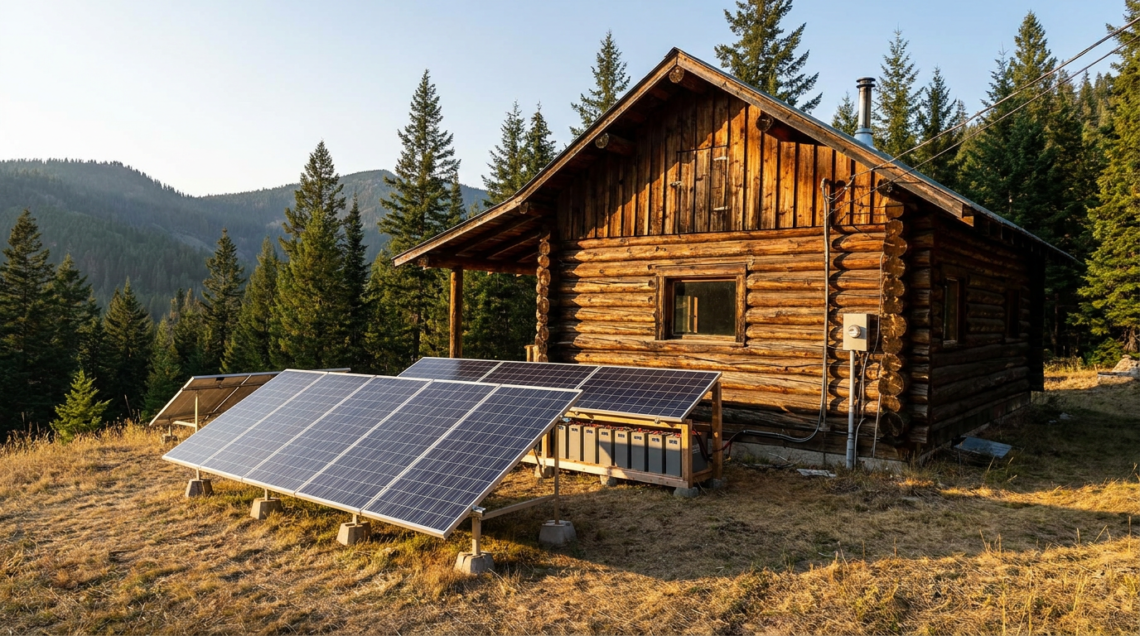
Thinking about going off-grid with solar? One of the biggest questions you’ll run into is: “How many batteries do you need?” It’s a crucial piece of the puzzle, and the short answer is: it depends on your energy use and how much backup you want. There’s no magic number, but we can break down what goes into figuring it out so you can make a smart choice for your situation. Let’s dive in and get practical about it.
Before you even look at battery banks, you need to get a solid grip on how much power you use, and when. This is the absolute starting point for sizing your off-grid battery system. If you skip this, you’re essentially guessing, and that can lead to either a system that’s too small and leaves you in the dark, or one that’s overkill and costs you a pretty penny unnecessarily.
Table of Contents
Daily Energy Consumption: Your Baseline
Think of this as your “average day” of electricity use. You’ll want to make a list, and I mean a real list, of every appliance and device you plan to run off your solar system. For each item, you need to find its power consumption, usually measured in watts (W). You can typically find this information on a label on the appliance itself, in its user manual, or by doing a quick online search for the model number.
Identifying Appliances and Their Wattage
- Big Power Hogs: These are your usual suspects for high energy use. Think refrigerators, freezers, electric heaters, air conditioners, electric stoves, microwaves, hair dryers, toasters, and power tools. Jot down their wattage. A refrigerator might be 100-200W running, but its compressor cycles on and off. A microwave can be 1000-1500W.
- Moderate Users: Lights (LEDs are great for this), TVs, computers, chargers, fans, pumps (like for water or well pumps). These might range from 10W for an LED bulb to 100-200W for a typical laptop or a small TV.
- Small Drains: Anything plugged in that uses very little power. USB chargers, small electronics, smart devices on standby. While individual draw is small, collectively they can add up over time.
Calculating Daily Watt-Hours (Wh)
Once you have the wattage for each appliance, you need to estimate how many hours a day you’ll use it. This is where honesty is key! Don’t overestimate or underestimate here.
- Example Calculation:
- Refrigerator: 150W average running, let’s say it runs 8 hours a day total (compressor cycles). So, 150W * 8 hours = 1200 Wh.
- LED Lights: 5 bulbs at 10W each = 50W. Used for 6 hours a day. So, 50W * 6 hours = 300 Wh.
- Laptop: 60W. Used for 4 hours a day. So, 60W * 4 hours = 240 Wh.
- Water Pump: 500W. Used for 0.5 hours (30 minutes) a day. So, 500W * 0.5 hours = 250 Wh.
Add up all these daily Watt-hours (Wh) for every appliance. This gives you your total daily energy consumption.
Peak Load: What Stresses Your System
Beyond average daily use, you need to consider your peak load. This is the highest amount of power you might draw from your batteries at any one time. This is critical because your inverter (which converts DC battery power to AC household power) has a maximum output capacity.
Identifying Simultaneous Loads
Think about scenarios:
- Morning Rush: Are you using the toaster, coffee maker, microwave, and charging your phone all at once?
- Evening Wind-Down: Is the TV on, lights on, computer running, and maybe a fan?
- Appliances with Motors: When an appliance with a motor starts up (like a refrigerator compressor, a well pump, or a washing machine), it draws a surge of power called inrush current, much higher than its running wattage. For example, a 500W pump might have an inrush of 2000W or more for a fraction of a second.
Calculating Peak Wattage
Sum up the wattage of all the appliances you think might be running simultaneously. Crucially, you need to account for the highest inrush current of any motor-driven appliance that could start up during that peak usage period.
- Example: If you might have your refrigerator (150W running, 1000W inrush), a microwave (1200W), and a laptop (60W) running at the same time, the peak load isn’t just the running watts. You need to consider the highest potential demand. If the fridge compressor kicks on while the microwave is running, that’s a significant surge. Your inverter needs to be sized to handle this peak, and your battery system needs to be able to deliver that power.
Seasonal Variations and Lifestyle Adjustments
Your energy use isn’t static. It changes with the seasons, and your lifestyle.
Summer vs. Winter Needs
- Summer: You might run fans or air conditioning more. However, you also have more solar power generation.
- Winter: Heating can become a massive energy drain if you’re using electric heaters. Days are shorter, meaning less solar charging. This is often the time when battery storage becomes most critical.
Changes in Lifestyle
Are you working from home more? Having guests? Planning renovations that will use power tools? These can all impact your energy consumption and the load on your battery system. It’s worth thinking about these possibilities and building in a little buffer.
When considering how many batteries you need for an off-grid solar system, it’s also essential to understand the overall costs associated with going off-grid. A related article that delves into the financial aspects of this transition is available at How Much Does It Cost to Go Off-Grid?. This resource provides valuable insights into the expenses involved, helping you make informed decisions about your off-grid solar setup.
Sizing Your Battery Bank: The Core Calculations
Now that you have a solid understanding of your energy needs, let’s talk about how that translates into actual battery capacity. This is where the numbers start to get serious.
Understanding Battery Capacity Units
Batteries are rated in Amp-hours (Ah) or Kilowatt-hours (kWh).
- Amp-hours (Ah): This tells you how many amps a battery can deliver for a certain number of hours. For example, a 100Ah battery at 12V can theoretically deliver 100 amps for 1 hour, or 10 amps for 10 hours.
- Kilowatt-hours (kWh): This is a more direct measure of energy. 1 kWh is equal to 1000 Watt-hours (Wh). Since we calculated our daily needs in Wh, working with kWh is often simpler when comparing different battery chemistries and system sizes.
Depth of Discharge (DoD): Protecting Your Investment
This is one of the most critical factors in battery longevity and overall system life. Depth of Discharge (DoD) refers to the percentage of the battery’s total capacity that has been discharged.
- Why it Matters: Continuously draining batteries close to 100% DoD will significantly reduce their lifespan. Think of it like stretching a rubber band too far—it loses its elasticity.
- Recommended DoD:
- Lead-Acid Batteries (AGM, Gel): You generally want to aim for a maximum DoD of 50%. This means you should only use half of its rated capacity to get the most cycles out of it. If you have a 10kWh lead-acid bank, you can only reliably use 5kWh.
- Lithium-ion Batteries (LiFePO4): These are much more forgiving. You can typically discharge them to 80% or even 90% DoD, significantly increasing the usable capacity compared to lead-acid for the same physical bank size. A 10kWh LiFePO4 bank could realistically provide 8-9kWh of usable energy.
Autonomy (Days of Backup): Your “Rainy Day” Factor
This is the number of days you want your system to be able to run without any solar charging. This is your buffer for cloudy weeks, unexpected system downtime, or extended periods of high energy use. This is a significant factor in how many batteries you’ll need.
Calculating Required Usable Capacity
- Total Daily Energy Use (Wh or kWh): From your earlier calculations. Let’s use kWh for ease here.
- Desired Autonomy (Days): How many days of backup do you want?
- Usable Energy Needed: Total Daily Energy Use (kWh) * Desired Autonomy (Days)
- Example: If your daily use is 12 kWh and you want 3 days of autonomy, you need a usable capacity of 12 kWh * 3 days = 36 kWh.
Total Battery Bank Size: Bringing It All Together
Now, we combine the usable energy needed with the DoD limitations of your chosen battery type.
- Usable Energy Needed (kWh): (From previous step)
- Battery DoD Limit (%): (e.g., 50% for lead-acid, 80% for LiFePO4) This should be expressed as a decimal (e.g., 0.50 or 0.80).
- Total Battery Bank Size (kWh): Usable Energy Needed (kWh) / Battery DoD Limit (%)
- Example (Continuing):
- If you want 36 kWh usable energy and are using LiFePO4 batteries with an 80% DoD:
Total System Size = 36 kWh / 0.80 = 45 kWh.
You’d need a battery bank rated for 45 kWh.
- If you were using lead-acid batteries with a 50% DoD for the same needs:
Total System Size = 36 kWh / 0.50 = 72 kWh.
You’d need a battery bank rated for 72 kWh.
This calculation highlights the significant difference in total bank size between battery chemistries for the same usable energy and autonomy.
Battery Chemistry Choices and Their Impact
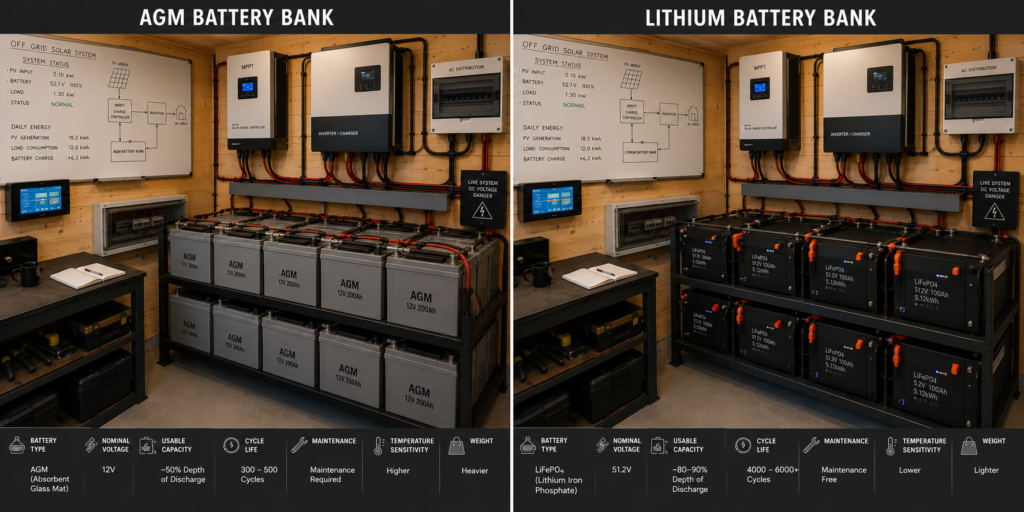
The type of battery you choose makes a huge difference in capacity, lifespan, cost, and how much physical space you’ll need. It’s not just about Wh; it’s about the whole package.
Lead-Acid Batteries (AGM, Gel)
These are the traditional choice for off-grid systems. They are generally less expensive upfront but come with drawbacks.
- Pros: Lower initial cost, widely available, mature technology.
- Cons: Shorter lifespan (fewer cycles), heavier and bulkier for the same usable capacity, sensitive to deep discharge (requires larger bank for same usable energy), require good ventilation (can off-gas hydrogen), slower charging.
- Key Considerations: You absolutely must respect the 50% DoD rule to get any reasonable lifespan. This means you’ll need a physically much larger and heavier battery bank compared to lithium for the same usable power. They also need regular maintenance (checking water levels for flooded types, though AGM and Gel are sealed).
Lithium-ion Batteries (LiFePO4)
Lithium iron phosphate (LiFePO4) is the dominant chemistry for modern off-grid solar due to its superior performance and longevity.
- Pros: Much longer lifespan (thousands of cycles), lighter and more compact for the same capacity, can be discharged to 80-90% DoD, faster charging, superior performance in cold temperatures (with proper battery management systems), maintenance-free.
- Cons: Higher upfront cost per kWh, though the total cost of ownership over their lifespan is often lower.
- Key Considerations: While the initial price can be a sticker shock, their dramatically longer lifespan, higher usable capacity, and lower weight often make them the more economical and practical choice in the long run. They also require a Battery Management System (BMS) for safety and longevity, which is usually integrated into modern LiFePO4 batteries.
Hybrid and Other Chemistries
While LiFePO4 is the current leader, other lithium chemistries exist, but LiFePO4 specifically is generally recommended for off-grid due to its safety profile and cycle life. Lead-acid remains an option for those with very tight upfront budgets or specific niche applications, but it necessitates more careful management.
System Design and Practicalities
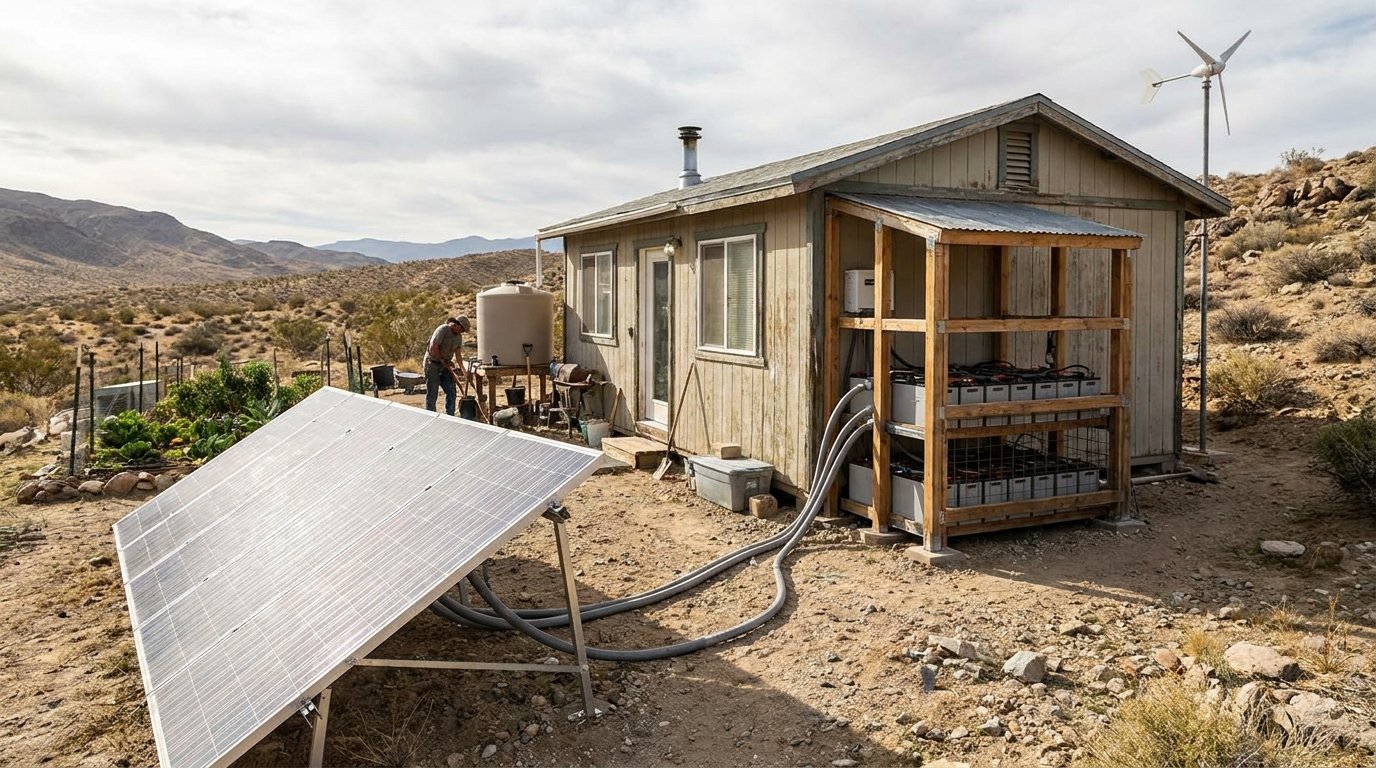
Beyond just the battery capacity, there are other real-world aspects to consider when planning your off-grid battery bank.
Battery Voltage: 12V, 24V, 48V?
The voltage of your battery bank affects system efficiency and the types of components you can use.
- 12V Systems: Common for smaller RVs or cabins. Simple, and many small appliances run on 12V directly. However, at 12V, higher power demands require very high amperage, leading to thicker, more expensive wiring and increased power loss. For anything beyond basic needs, 12V quickly becomes inefficient.
- 24V Systems: A good compromise for medium-sized systems. Offers better efficiency than 12V for higher loads and allows for smaller, more manageable wiring.
- 48V Systems: Ideal for larger homes or heavy energy users. Highly efficient, allowing for smaller wiring and reducing energy loss over longer cable runs. Most professional off-grid solar equipment (inverters, charge controllers) are designed to work with 24V or 48V systems.
General Rule: The higher the voltage, the lower the amperage for the same power, and thus the more efficient and cost-effective your wiring will be. For most serious off-grid homes, 48V is the preferred choice for efficiency and scalability.
Battery Location and Environmental Factors
Where you put your batteries matters.
- Temperature: Batteries don’t like extreme temperatures.
- Too hot: Accelerates degradation and reduces lifespan.
- Too cold: Significantly reduces performance and capacity, especially for lead-acid. Lithium can manage cold better if the BMS has a low-temperature disconnect/heater, but it still has limits.
- Ventilation: Crucial for lead-acid batteries, which can release explosive hydrogen gas. They should be in a well-ventilated area, usually outdoors or in a dedicated battery shed with passive or active ventilation. Lithium batteries do not off-gas, so ventilation is less of a concern for safety, but keeping them within their optimal temperature range is still important.
- Accessibility: Batteries are heavy, especially lead-acid. Ensure you have clear access for installation and any potential maintenance. Consider how you’ll move them.
- Protection: Batteries should be protected from physical damage, moisture, and unauthorized access.
Wiring and Safety Considerations
The size and quality of your wiring are directly related to your battery bank’s voltage and amperage.
- Gauge of Wire: Higher amperage (lower voltage systems) requires much thicker wires (lower gauge number) to prevent overheating and voltage drop. Incorrectly sized wiring is a fire hazard and significantly reduces system performance.
- Fuses and Breakers: Essential safety devices to protect against short circuits and overloads. Your battery bank needs proper fusing, ideally at the battery terminals and near the inverter/charge controller.
- Grounding: Proper grounding of your system components is vital for safety and system integrity.
- Professional Installation: If you are not thoroughly comfortable with electrical systems, especially DC systems, hiring a qualified solar installer for your battery bank and related wiring is highly recommended. Mistakes here can be dangerous and costly.
When planning your off-grid solar system, understanding the number of batteries you need is crucial for ensuring a reliable power supply. To further enhance your knowledge about off-grid living, you might find it helpful to explore common pitfalls that beginners encounter. For instance, an insightful article discusses various mistakes that can derail your off-grid journey, providing valuable tips to avoid them. You can read more about these challenges in this related article.
The Role of Solar Production and Charge Controllers
| Appliance | Wattage (W) | Hours of Use per Day | Total Daily Energy Consumption (Wh) |
|---|---|---|---|
| LED Light Bulb | 10 | 4 | 40 |
| Refrigerator | 150 | 24 | 3600 |
| Television | 100 | 6 | 600 |
| Laptop | 50 | 8 | 400 |
| Fan | 75 | 10 | 750 |
Your batteries are only part of the equation; how they get charged is equally important.
Solar Array Size: Matching Generation to Consumption
Your solar panel array needs to be large enough to recharge your batteries after use and power your loads during daylight hours.
- Oversizing Panels: It’s often beneficial to slightly oversize your solar array compared to your daily energy needs. This helps ensure that even on less sunny days, you can still generate enough power to keep your batteries topped up.
- Matching Solar to Loads: Consider your peak usage times. If you use a lot of power in the evening, your solar panels won’t be generating much then, so your battery bank needs to cover that. Conversely, if your highest usage is during peak sun hours, your panels can offset some of that demand directly.
Charge Controllers: The Battery’s Guardian
A charge controller is essential. It regulates the flow of electricity from your solar panels to your batteries, preventing overcharging and optimizing charging efficiency.
- MPPT vs. PWM:
- PWM (Pulse Width Modulation): A simpler, less expensive technology. It’s less efficient, especially when the panel voltage is significantly higher than the battery voltage.
- MPPT (Maximum Power Point Tracking): More advanced and efficient. It can harvest significantly more energy from your solar panels (up to 30% more) by optimizing the voltage and current combination. For off-grid systems, MPPT is almost always the superior choice due to its efficiency gains, which translate directly to more charging power for your batteries.
- Battery Type Compatibility: Ensure your charge controller is compatible with your chosen battery chemistry (lead-acid, lithium). Many modern MPPT controllers have settings for various battery types.
Battery Monitoring Systems (BMS)
For lithium-ion batteries, a Battery Management System (BMS) is an absolute must. It monitors individual cell voltages, temperature, and balances the cells to ensure optimal performance and safety. It also provides protection against overcharging, over-discharging, and extreme temperatures. Most integrated lithium battery packs come with a built-in BMS. For lead-acid, monitoring is still important, but it’s more about tracking overall battery bank health and State of Charge (SoC) using a separate battery monitor.
When considering how many batteries you need for off-grid solar systems, it’s also helpful to explore other essential aspects of off-grid living. For instance, you might find valuable insights in a related article that addresses common questions beginners have about this lifestyle. Understanding these fundamentals can significantly enhance your planning process. You can read more about it in this informative piece on essential off-grid living FAQs for beginners.
Real-World Scenarios: Putting It All Together
Let’s look at a couple of hypothetical examples to see how these calculations play out in practice.
Scenario 1: Small Cabin for Weekend Use
- Goal: Power basic lights (LEDs), charge phones/laptops, run a small fridge, and occasionally a water pump for a few hours. Primarily weekend use, with weekday charging.
- Estimated Daily Usage:
- Fridge: 150W * 8 hours = 1200 Wh
- Lights: 50W * 5 hours = 250 Wh
- Phone/Laptop Charging: 75W * 3 hours = 225 Wh
- Water Pump: 500W * 1 hour = 500 Wh
- Total Daily ~ 2.2 kWh
- Autonomy: 2 days (for those cloudy weekends)
- Usable Energy Needed: 2.2 kWh/day * 2 days = 4.4 kWh
- Battery Choice: LiFePO4 (80% DoD)
- Total System Size: 4.4 kWh / 0.80 = 5.5 kWh
- Hardware Example: A 48V 120Ah LiFePO4 battery bank would provide 48V * 120Ah = 5760 Wh = 5.76 kWh, which is an excellent fit. You might even get away with a slightly smaller 48V 100Ah bank (4.8kWh) if you’re really careful with usage on non-sunny days, but 120Ah provides good peace of mind.
Scenario 2: Full-Time Residence with Modern Appliances
- Goal: Power a whole house with standard appliances, including a refrigerator, washing machine, TV, computers, lights, and potentially electric heating (though this drastically increases needs).
- Estimated Daily Usage: This can vary WILDLY. Let’s conservatively estimate a moderate household use.
- Refrigerator: 150W * 10 hours = 1500 Wh
- Lights (LEDs across house): 100W * 8 hours = 800 Wh
- TV: 70W * 5 hours = 350 Wh
- Computers/Charging: 150W * 6 hours = 900 Wh
- Washing Machine (estimate 2 cycles): 500W running, 1.5 hours/cycle (consider spin cycle surge) ~ 1500 Wh
- Water Heater (solar thermal preferred, but let’s say electric backup): 2000W * 1 hour = 2000 Wh
- Total Daily ~ 7.05 kWh (This is quite low for a full-time home and doesn’t include AC or electric heating, which would easily double or triple this).
- Autonomy: 3 days
- Usable Energy Needed: 7.05 kWh/day * 3 days = 21.15 kWh
- Battery Choice: LiFePO4 (80% DoD)
- Total System Size: 21.15 kWh / 0.80 = 26.4 kWh
- Hardware Example: You might look at several 48V 100Ah LiFePO4 batteries wired in parallel to achieve this. Six of them would give you 48V * 600Ah = 28.8 kWh total capacity, providing ample usable energy. If you were using lead-acid, you’d need a bank approximately twice this size (around 53kWh total capacity), meaning a very large and heavy setup.
These are simplified examples, but they start to show how the numbers stack up. The biggest variables are your daily energy consumption and your desired autonomy.
Final Thoughts on Sizing
Figuring out how many batteries you need for an off-grid solar system isn’t complicated math, but it does require careful consideration of your unique situation.
- Be Realistic: Accurately estimating your energy usage is paramount. Don’t guess; measure if you can.
- Prioritize Longevity: Investing in quality batteries (like LiFePO4) and respecting their DoD limits will save you money and hassle in the long run.
- Consider Scalability: Think about your future needs. Can your system be expanded later if your energy demands increase?
- Don’t Skimp on Safety: Electrical systems carry inherent risks. If in doubt, get professional advice.
It’s a significant investment, so taking the time to do these calculations accurately will set you up for a reliable and functional off-grid power system. Good luck!
FAQs
1. What is off-grid solar power?
Off-grid solar power refers to a system that generates electricity from solar panels and stores it in batteries for use when the sun is not shining. This allows for independent power generation and usage, without relying on the grid.
2. How many batteries are needed for off-grid solar power?
The number of batteries needed for off-grid solar power depends on the energy consumption of the household or facility, as well as the capacity of the solar panels. A general rule of thumb is to have enough battery storage to last through several days of low sunlight, typically around 3-5 days.
3. What factors determine the number of batteries required for off-grid solar power?
Factors that determine the number of batteries needed for off-grid solar power include the daily energy consumption, the capacity of the solar panels, the efficiency of the battery system, and the desired level of autonomy (number of days the system can operate without sunlight).
4. How do I calculate the number of batteries needed for my off-grid solar system?
To calculate the number of batteries needed for an off-grid solar system, you can start by determining the daily energy consumption in kilowatt-hours (kWh), then factor in the efficiency of the battery system and the desired level of autonomy. This calculation will give you an estimate of the total battery capacity required.
5. What are the different types of batteries used for off-grid solar power?
The most common types of batteries used for off-grid solar power systems are lead-acid batteries, lithium-ion batteries, and saltwater batteries. Each type has its own advantages and disadvantages in terms of cost, lifespan, and performance.



One comment on “How Many Batteries Do You Need for Off-Grid Solar?”