So, you’re thinking about off-grid living and composting toilets? Smart move. They’re a fantastic way to manage waste sustainably when you’re disconnected from traditional plumbing. But with so many options out there, figuring out the “best” one can feel like a puzzle.
Honestly, the “best” composting toilet for you really depends on your specific needs and priorities. Are you going for super low-maintenance? Do you need something that handles a lot of use? Budget a big concern? We’re going to break down some of the top contenders and what makes them tick, so you can make an informed decision.
Table of Contents
Understanding the Core Mechanics: How Composting Toilets Actually Work
Before we dive into specific models, it’s helpful to understand the basic principles behind most composting toilets. They’re not just fancy buckets; they’re designed to facilitate the natural process of decomposition.
The Two Main Systems: Separating Liquids and Solids
The key to preventing odors and ensuring efficient composting lies in managing moisture and airflow. Most modern composting toilets achieve this by separating liquids from solids.
Liquid-Solid Separation (LSS)
This is the most common and effective approach. When you use the toilet, liquids (urine) are channeled away into a separate collection container. Solids (feces and toilet paper) fall into a primary composting chamber. This separation is crucial because urine is mostly sterile, while solids require a different breakdown process. Separating them prevents the wet, anaerobic conditions that lead to foul smells.
Advantages of LSS
- Odor Control: By keeping urine from mixing with solids, you drastically reduce the potential for ammonia production and bad smells.
- Compost Quality: Separated solids can compost more efficiently and aerobically, producing a more stable and useful end product.
- Easier Maintenance: Emptying urine containers is generally straightforward and less unpleasant than dealing with mixed waste.
The Role of Bulking Material
This is your secret weapon against odors and for creating good compost. After each use, you add a carbon-rich material to the solids chamber.
What is Bulking Material?
Think sawdust, peat moss, coconut coir, or even finely shredded paper. This material absorbs moisture from the solids, adds vital carbon for the microbes, and helps create an airy environment for aerobic decomposition.
How Much and When to Add It
A good rule of thumb is to add a generous scoop after each bowel movement. For urination, a light sprinkling might suffice, or some systems have a secondary small pour for liquids only. The goal is to keep the solids mixture light and dry, preventing clumping.
The Composting Process: Microbes at Work
Once the solids are in the chamber, a colony of aerobic bacteria, fungi, and other microorganisms gets to work, breaking them down.
Aerobic vs. Anaerobic Decomposition
Aerobic decomposition, which is what composting toilets aim for, requires oxygen. It’s a relatively fast and odorless process that turns waste into a nutrient-rich humus. Anaerobic decomposition, on the other hand, happens without oxygen and is what causes the putrid smells associated with rotting waste.
Factors Affecting Composting Speed
- Temperature: Warmer temperatures generally speed up decomposition. Some advanced systems have heating elements.
- Moisture: Too much moisture leads to anaerobic conditions. Too little can slow down the microbes. The bulking material helps regulate this.
- Oxygen: Good airflow is paramount. This is often achieved through venting.
- Microbial Population: A healthy, active colony of microbes is essential.
If you’re exploring sustainable solutions for off-grid living, you might find our related article on Off-Grid Living for Beginners: Simple Guide particularly helpful. This guide provides essential tips and insights for those new to off-grid lifestyles, covering everything from energy sources to waste management, including the benefits of composting toilets. Understanding these fundamentals can greatly enhance your experience and efficiency in off-grid living.
Top Composting Toilets for Off-Grid Living: Our Picks & Why
Choosing the right model depends heavily on your situation. Some are designed for maximum self-sufficiency, while others prioritize ease of use and capacity.
1. Nature’s Head Composting Toilet
This is often the go-to for serious off-gridders, and for good reason. It’s robust, reliable, and has a proven track record.
Key Features and Design
The Nature’s Head is a self-contained unit that excels at liquid-solid separation. It features a robust urine diverter and a generously sized solids chamber. The design is intentionally simple, minimizing moving parts that can break.
Capacity and Usage
It’s designed for two to four people for extended periods, depending on usage habits. The solids chamber typically holds enough material for several weeks of use before needing to be emptied.
Maintenance and Emptying
Emptying involves detaching the solids bucket and then the urine jug. The solids can be emptied into a compost bin or designated area. The urine can be diluted and used as fertilizer or disposed of responsibly. Regular addition of bulking material is key.
Pros
- Highly effective odor control.
- Durable and built for harsh conditions.
- Excellent liquid-solid separation.
- Relatively compact for its capacity.
Cons
- Can be more expensive upfront.
- Emptying the solids bucket requires some physical effort and can be a bit messy if not done correctly.
- Requires regular addition of bulking material, which you’ll need to store.
Ideal For
- Full-time off-grid living.
- People who prioritize reliability and long-term performance.
- Those comfortable with a bit more hands-on maintenance.
2. Air Head Composting Toilet
Another strong contender in the high-performance category, the Air Head offers similar functionality to the Nature’s Head but with some subtle differences in design and user experience.
Design Philosophy
Like the Nature’s Head, the Air Head focuses on effective liquid-solid separation for odor-free operation. It uses a similar approach with a diverter and a removable solids compartment.
Capacity and User Base
It’s also well-suited for a few people living off-grid. The capacity is comparable to the Nature’s Head, making it a good choice for permanent installations.
Maintenance and Eco-Friendliness
Maintenance is similar: regular addition of bulking material and periodic emptying of the urine jug and solids chamber. The resulting compost is safe to use on non-edible plants after proper composting.
Pros
- Excellent odor control.
- Sturdy construction.
- Proven off-grid performance.
- Good separation system.
Cons
- Similar complexity in emptying to the Nature’s Head.
- Upfront cost is a factor.
- Requires diligent use of bulking material.
Ideal For
- Similar demographics to the Nature’s Head: dedicated off-gridders.
- Those who might find the specific shape or user interface of the Air Head to be slightly more appealing.
3. Separett Compost Toilet (Various Models)
Separett offers a range of composting toilets, often focusing on a slightly different approach that can appeal to those seeking a more integrated solution, especially in cabins or smaller dwellings.
The Separett Difference: Direct Composting
While many Separett models also separate liquids, some are designed for direct composting of both solids and a small amount of liquid within the unit itself, relying on a large composting chamber and often a passive venting system.
Benefits of Separett Systems
They often emphasize a more passive approach, meaning less hands-on emptying for the solids chamber. The concept is that the waste decomposes directly within the unit or in an attached external composter.
Types of Separett Toilets
- Villa Series: These are often waterless, producing compost directly or in an attached bin, with urine managed separately. They are designed for a more permanent, integrated feel.
- Tiny Series: Smaller, more compact versions suitable for smaller spaces or less frequent use.
Maintenance and Longevity
The maintenance varies by model. For those with larger chambers, emptying might be infrequent (months or even a year for very light use). Urine management is typically straightforward.
Pros
- Can offer very infrequent solids emptying.
- Some models are designed for seamless integration into a dwelling.
- Reliable passive venting systems on many models.
Cons
- Can be more expensive.
- The composting process within the unit itself might require more patience and specific conditions.
- Some models have a larger footprint.
Ideal For
- Cabin owners or those with less frequent or lower volume usage.
- People who prefer a “set it and forget it” approach with less frequent solids management.
- Those who want a more ‘built-in’ toilet feel.
4. Biolet Composting Toilet
The Biolet is known for its robust construction and often features an integrated fan for active aeration, which helps speed up the composting process.
Active Aeration System
A key selling point of the Biolet is its powered aeration. A fan actively circulates air through the composting material, promoting aerobic decomposition and reducing odors significantly.
Solids and Liquids Management
It typically follows the liquid-solid separation principle. Urine is diverted, and solids are deposited into a chamber where the fan aids in the decomposition process.
Capacity and Use Cases
Biolet toilets are often rated for a specific number of full-flush equivalents or person-days, making it easier to gauge their suitability for your household size.
Pros
- Very effective odor control due to active aeration.
- Faster composting process.
- Durable construction.
- Can handle higher usage than passive systems.
Cons
- Requires an electrical source for the fan, which might be a consideration for some off-grid setups (though many run on low voltage DC).
- Can be more expensive due to the fan and electrical components.
- Emptying can still be a manual process.
Ideal For
- Off-grid living where consistent odor control is a top priority.
- Households with moderate to higher usage.
- Those with a reliable, low-voltage power source.
5. Sun-Mar Composting Toilet (Various Models)
Sun-Mar offers a range of composting toilets, many of which feature a unique design that can be very effective, especially their self-contained units.
Passive vs. Self-Contained Designs
Sun-Mar has both self-contained units (like the X-GR) and models designed to be connected to a larger external composting chamber or bin.
The “Dry” Composting Approach
Sun-Mar often emphasizes a “dry” composting approach, meaning the solids chamber is designed to stay as dry as possible, with liquids being diverted. This helps prevent odors and promotes efficient decomposition.
Notable Models and Features
- Sun-Mar X-GR: A popular self-contained unit that’s designed for easy installation and maintenance. It features good liquid diversion and a decent solids capacity.
- Sun-Mar GTG (Go-To-Go): A very compact and portable option, often used for RVs or temporary off-grid situations.
Maintenance and Disposal
Maintenance involves adding bulking material and emptying the urine jug. For the self-contained units, the solids chamber needs to be emptied periodically. The composted material is then ready for disposal.
Pros
- Good odor control, especially in self-contained models.
- Variety of models to suit different needs and budgets.
- Some models are very compact and easy to install.
- Reputable brand with a long history.
Cons
- Capacity can be a limitation for larger households in some models.
- Some models require a bit more effort in emptying solids.
- Can be moderately priced, depending on the model.
Ideal For
- Smaller off-grid dwellings, cabins, or temporary setups.
- People looking for reliable, relatively easy-to-maintain solutions.
- Those who appreciate the option of both self-contained and externally connected systems.
Considerations for Off-Grid Living: Beyond the Toilet Itself
Choosing a composting toilet is just one piece of the puzzle. You also need to consider how it fits into your overall off-grid lifestyle.
Power Requirements: To Fan or Not to Fan?
Many composting toilets rely on passive venting, which is great for true “off-grid” in the sense of no external power. However, some models include a fan for active aeration.
Passive Venting
This is the simplest and most reliable for extreme off-grid. A vent pipe runs from the composting chamber up through the roof, allowing for air exchange and carrying away any gases. It relies on natural convection and wind.
Active Aeration (Fans)
Fans speed up the composting process and drastically improve odor control. If you have a solar power setup, a low-voltage DC fan is a very manageable power draw. This is a significant upgrade for performance if you can accommodate it.
Waterless vs. Water-Reducing Systems: A Nuance
It’s important to clarify what “waterless” means in this context. Composting toilets themselves are waterless in terms of flushing, but some might use a small amount of water for a “rinse” of the solids chamber or for cleaning.
True Waterless
These systems use no water whatsoever beyond what’s naturally present in waste. They rely entirely on bulking material and airflow.
Water-Reducing
Some systems might have a very small water flush to help move solids, but they are still vastly more water-efficient than conventional toilets. For off-grid, water conservation is key, so even water-reducing systems can be a good option if they meet your needs.
Maintenance and End-of-Life: A Practical Guide
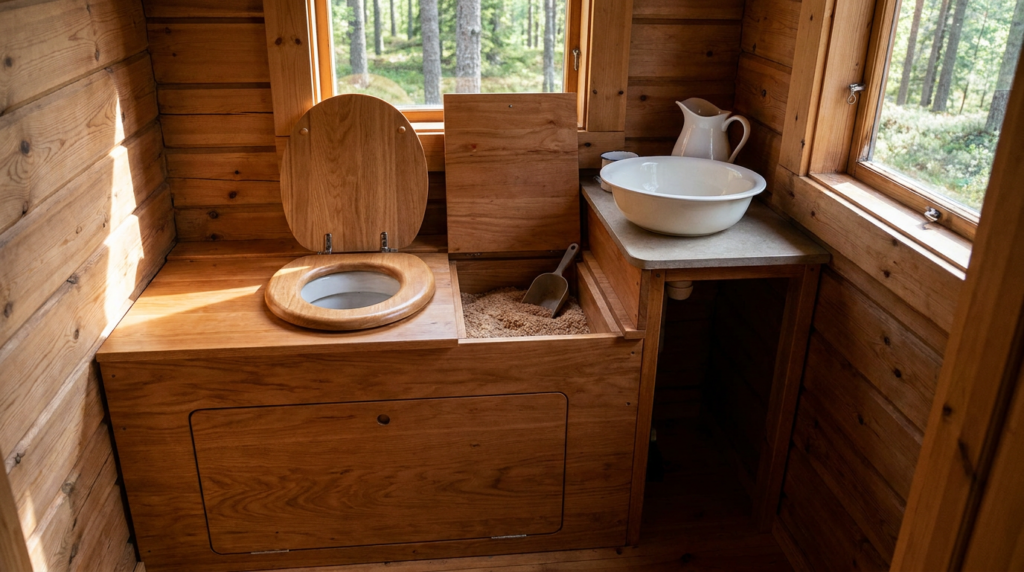
Composting toilets aren’t “install and forget.” They require regular attention.
Daily and Weekly Tasks
- Daily: Add bulking material after each use, check the urine level.
- Weekly/Bi-weekly: Empty the urine jug, add more bulking material if needed.
- Monthly/Quarterly (depending on capacity and usage): Empty the solids chamber.
Composting the Solids
Once emptied, the solids need to be composted properly. This usually means adding them to a larger compost pile where they can finish decomposing over several months. The goal is to reach temperatures that kill pathogens. This is crucial for safety and usability of the final compost.
Dealing with Urine
Urine can be diluted with water (10:1 or more) and used as a nitrogen-rich fertilizer for non-edible plants. Alternatively, it can be disposed of in a greywater system or a designated leach pit.
Storage and Disposal of Compost
This is a critical aspect of responsible composting toilet use.
The Two-Stage Composting Process
Most experts recommend a two-stage composting process. The initial decomposition happens in the toilet’s chamber. The secondary composting occurs in a separate, larger compost bin or pile. This ensures sufficient heat and time for pathogen destruction.
Suitable Compost Areas
Your compost pile should be in a location that allows for good aeration and drainage. It can be a simple enclosed bin or a freestanding pile. Turning the compost regularly helps with aeration and speeds up decomposition.
Final Use of Compost
Once fully composted and safe, the material can be used as a soil amendment for gardens, trees, and shrubs. Avoid using it on edible crops directly unless you are absolutely certain of the composting process and local regulations.
Frequently Asked Questions About Composting Toilets
If you’re considering the best composting toilets for off-grid living, you might also find it helpful to explore options for sustainable energy solutions. A related article on off-grid solar systems can provide valuable insights into which systems are best suited for your needs. By integrating efficient solar power with your composting toilet setup, you can enhance your off-grid experience. For more information, check out this guide on off-grid solar systems.
What is the best value composting toilet?
“Best value” is subjective, but for a balance of performance, durability, and cost, the Nature’s Head and Air Head often come up. They are a significant investment but provide reliable, long-term off-grid solutions. If budget is extremely tight, you might consider DIY options, but they require more knowledge and effort to get right.
How often do I need to empty a composting toilet?
This varies greatly depending on the toilet’s capacity, the number of people using it, and how diligently you add bulking material. For a self-contained unit like the Nature’s Head, it could be anywhere from a few weeks to a couple of months for a small household. For larger, externally connected composting systems (like some Separett models), emptying might only be needed seasonally or annually.
Do composting toilets smell bad?
A properly functioning and maintained composting toilet should not smell bad, certainly not like a traditional septic system or porta-potty. Any unpleasant odors are usually a sign of a problem, most commonly:
- Lack of aeration: Not enough airflow in the solids chamber.
- Too much moisture: Leading to anaerobic conditions.
- Insufficient bulking material: Not enough carbon to absorb moisture and provide air.
- Improper liquid-solid separation: If urine is mixing with solids.
Regularly adding bulking material, ensuring good airflow through the vent, and emptying the urine container promptly are key to odor-free operation.
Can I use a composting toilet during winter?
Yes, you can, but it requires more attention. Composting slows down significantly in cold temperatures.
- Insulation: You’ll want to insulate the toilet and the vent pipe to prevent freezing.
- Bulking Material: You might need to add bulking material more frequently to manage moisture and keep the chamber from becoming too solid.
- Composting Speed: Expect the decomposition process to be much slower or even halt in very cold weather. The solids will essentially be stored until warmer temperatures return. Some people use a small heater or a heated compost chamber in extreme climates.
What is the end result of composting toilet waste?
The end result, after proper secondary composting, is a nutrient-rich, dark, crumbly material that resembles soil or humus. It’s a stable, sanitized compost that can be used as a valuable soil amendment. It’s essentially nature’s way of recycling waste into valuable resources.
Is a composting toilet environmentally friendly?
Yes, composting toilets are an excellent environmentally friendly option for off-grid living. They:
- Eliminate the need for septic systems or sewer hookups: This reduces the impact on land and water resources.
- Conserve water: They use no or very little water for flushing, unlike conventional toilets.
- Recycle nutrients: They turn human waste into a valuable resource for soil enrichment.
- Reduce pollution: They prevent untreated waste from entering waterways.
Choosing the “best” composting toilet for your off-grid adventure is a step towards self-sufficiency and environmental responsibility. Take your time, consider your priorities, and you’ll find a solution that works perfectly for your new lifestyle.
FAQs
What are composting toilets?
Composting toilets are a type of toilet that uses the natural process of decomposition to break down waste into compost. They are designed to be used without access to traditional sewage systems and are often used in off-grid living situations.
How do composting toilets work?
Composting toilets work by separating liquid and solid waste. The solid waste is mixed with organic material such as sawdust or peat moss to aid in the decomposition process. Over time, the waste breaks down into compost, which can then be safely disposed of or used as fertilizer.
What are the benefits of using a composting toilet for off-grid living?
Composting toilets are environmentally friendly, as they reduce the need for water and eliminate the pollution associated with traditional sewage systems. They also provide a sustainable way to manage waste in off-grid living situations, where access to traditional plumbing may be limited.
What should I consider when choosing a composting toilet for off-grid living?
When choosing a composting toilet for off-grid living, it’s important to consider factors such as capacity, ventilation, and maintenance requirements. Additionally, the size and design of the toilet should be suitable for the specific off-grid living situation.
Are there different types of composting toilets available for off-grid living?
Yes, there are several types of composting toilets available for off-grid living, including self-contained units, central systems, and electric or non-electric options. Each type has its own set of features and considerations, so it’s important to research and choose the best option for your specific off-grid living needs.